If you have ever wondered whether professional car care is a passing trend or a permanent shift in vehicle maintenance, the numbers reveal a clear reality. Depending on how you define the market, professional car care sits somewhere between a $15 billion U.S. market and a $58 billion global industry. Nearly every major research firm tracking these auto detailing industry statistics points in the exact same direction – straight up.
This comprehensive guide pulls together verified figures from the industry’s most-cited research firms, including Grand View Research, Fortune Business Insights, Global Market Insights, Precedence Research, and IBISWorld. This analysis gives you one clear, accurate picture of where the auto detailing market stands today, where it is headed, and why different online estimates don’t always agree.
Key Auto Detailing Industry Statistics
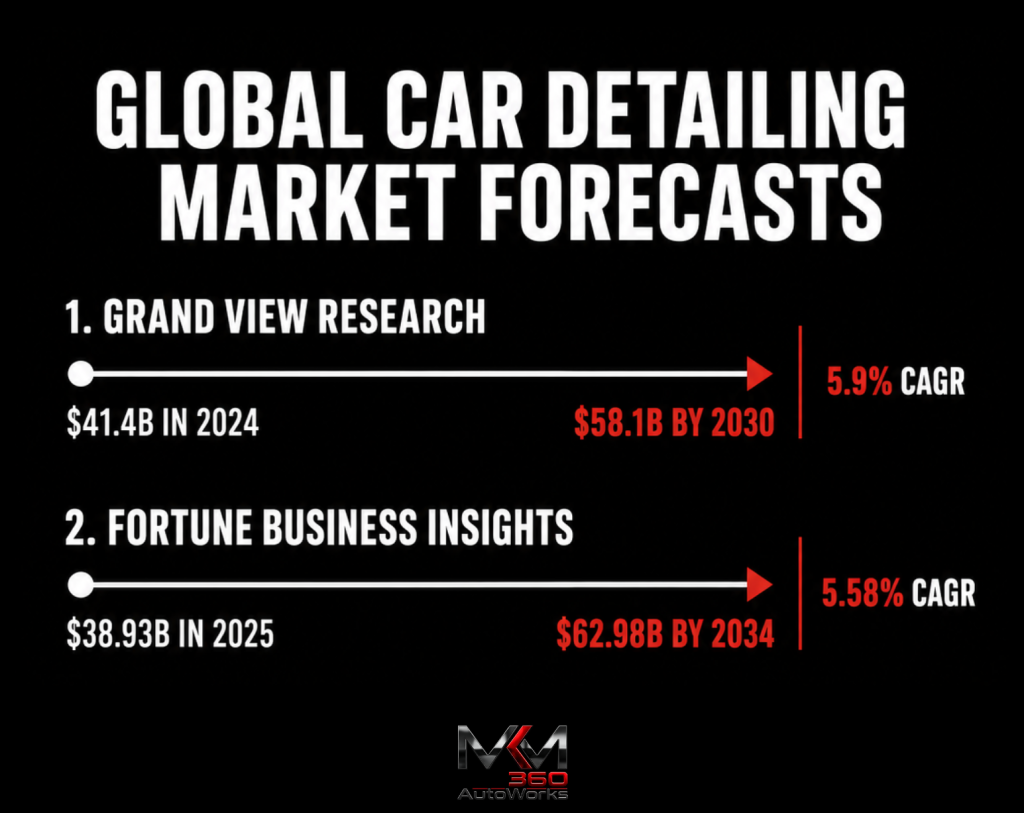
- A separate estimate puts 2025 global revenue at $38.93 billion, growing to $62.98 billion by 2034 (5.58% CAGR)
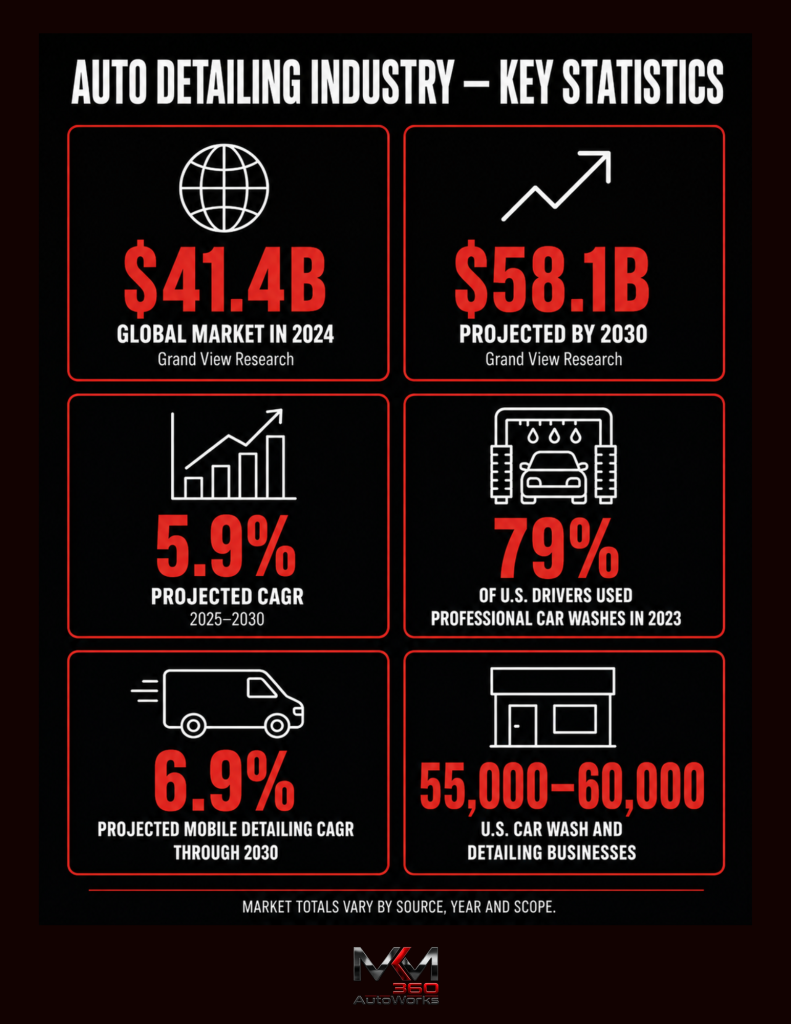
- Global car detailing services market: $41.4 billion in 2024
- Projected to reach $58.1 billion by 2030 (5.9% CAGR, 2025-2030)
- Professional car wash usage among U.S. drivers rose from 48% in 1996 to 79% in 2023, according to the International Carwash Association
- Exterior detailing accounted for roughly 64%-67% of the global market in recent estimates, depending on the source
- On-demand and mobile detailing is projected to grow at roughly 6.9% CAGR through 2030, outpacing conventional service stations
- Interior detailing is the fastest-growing service category, with CAGR estimates ranging from 6.7% to 7.3% depending on the research firm
Global Auto Detailing Market Size
Ask five research firms how big the global car detailing market is, and you’ll get five different, but directionally similar answers. Here’s how the major estimates stack up:
| Source | Current Estimate | Forecast | CAGR |
| Grand View Research | $41.4B (2024) | $58.1B by 2030 | 5.9% |
| Fortune Business Insights | $38.93B (2025) | $62.98B by 2034 | 5.58% |
Why do market estimates vary so much?
Three factors explain most of the gap:
1. Different scope definitions
Some reports measure pure detailing services (washing, waxing, paint correction, interior restoration). Others fold in adjacent categories like conveyor car washes, in-bay automatics, and self-service bays.
A U.S.-focused industry overview from IBISWorld-sourced data explicitly notes this trend. Broader definitions include ancillary car wash revenue from gas stations and dealerships. These inclusive metrics produce meaningfully higher totals than definitions limited strictly to dedicated detailing and car wash establishments.
2. Shared underlying data, independently modeled dollars
Some reports that look independent on the surface share nearly identical segmentation percentages, like the same exterior-vs-interior split, the same SUV-vs-sedan split, down to the decimal, while producing different absolute dollar figures.
This pattern suggests some firms license or derive from common syndicated datasets, then apply their own market-sizing models on top. It’s worth knowing when you’re comparing “independent” sources that may not be as independent as they appear.
3. Different base years and timelines
When you see a car detailing market-size figure, check the actual years the researchers analyzed. A study that uses older data will not match a study that includes recent price inflation and changes in how people spend money. A $15 billion figure and a $58 billion figure can both be right at the same time, they are just looking at different years and measuring different things.
U.S. Car Wash and Auto Detailing Statistics
The U.S. market is the most heavily documented single geography, largely thanks to IBISWorld’s ongoing coverage of NAICS code 81119a (Car Wash & Auto Detailing).
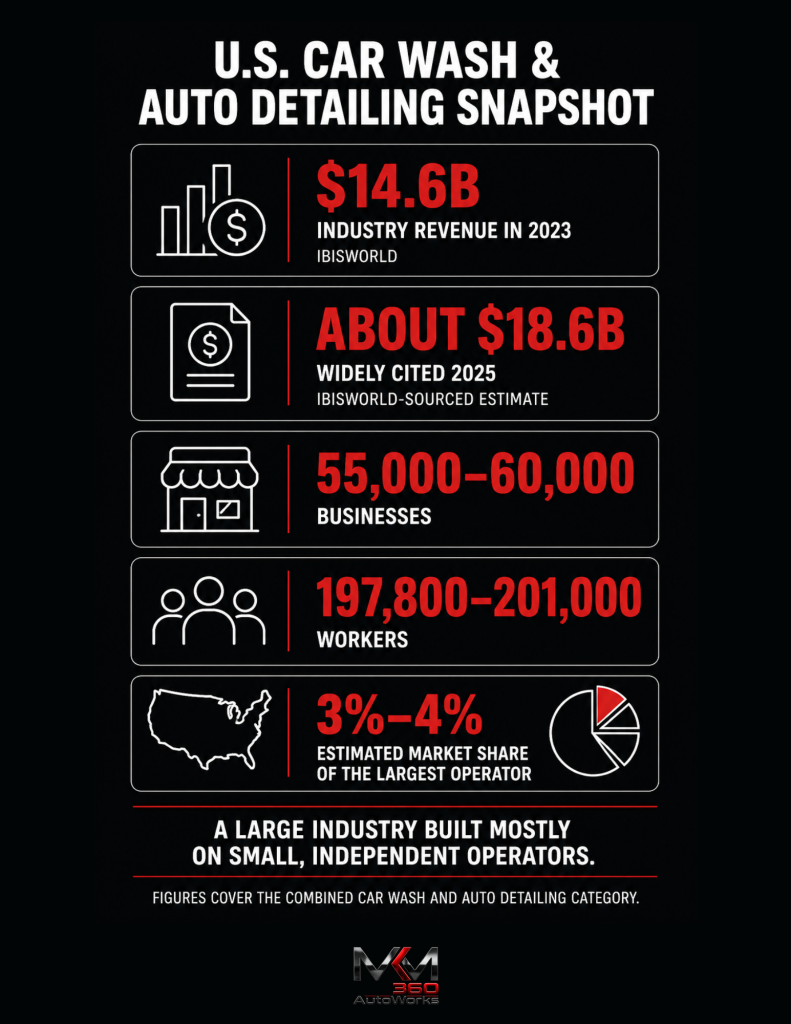
- U.S. industry revenue – $14.6 billion in 2023, rising to an estimated $18.6 billion in 2025
- Businesses operating in the space – Roughly 55,000-60,000, with one estimate putting the 2024 figure at 57,900, up about 2% year-over-year
- Employment – 197,800 workers in 2024
- Average revenue per establishment – Roughly $250,000-$313,000, reflecting an industry built on small, single-location operators
- Industry profit margins – Approximately 12-14%, with analysts projecting higher margins as express-format car washes gain market share
- Market concentration – Even the largest operator, Mister Car Wash, holds only an estimated 3-4% market share; no single company dominates
This fragmentation is one of the most consistent findings across every U.S.-focused source. Independent, single-location operators account for the overwhelming majority of industry revenue. In fact, the two most frequently named “largest” companies in some datasets hold a combined share under 1%. These specific entities are vehicle inspection firms, not detailing chains.
Market growth has been steady but not dramatic. Most projections through the late 2020s forecast low single digits annually. This trajectory reflects a mature industry rather than an emerging market.
Car Detailing vs. Car Wash Statistics
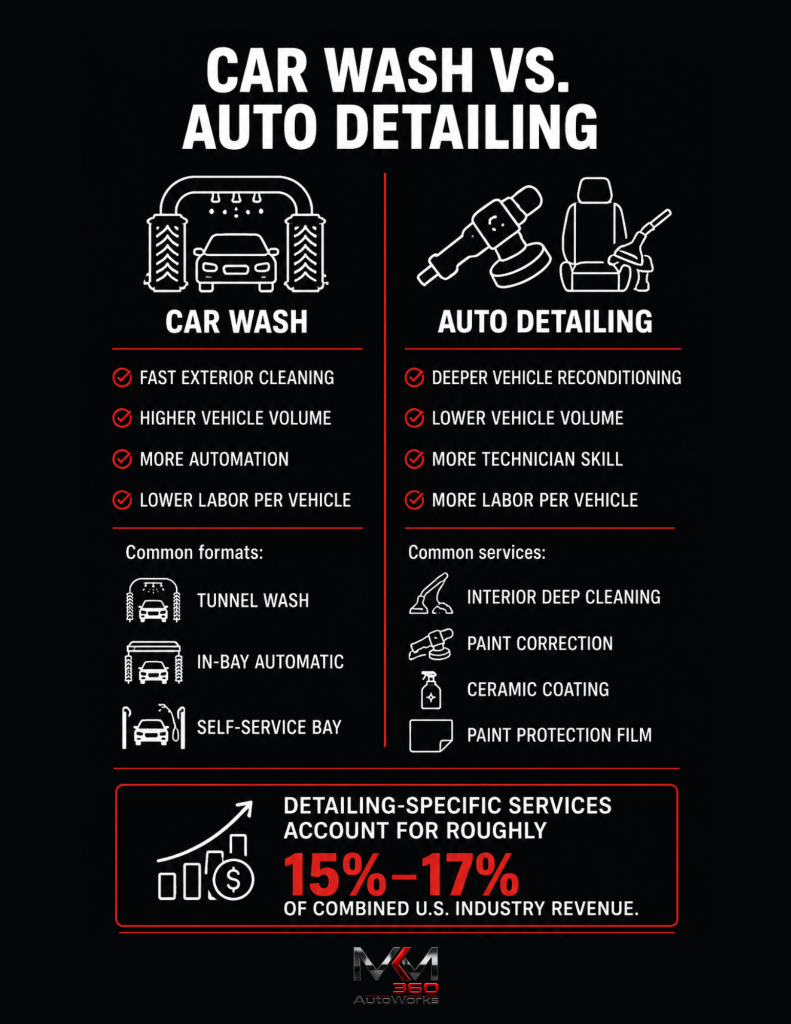
Many of the market-size figures above blend car washing and professional detailing, two related but distinct services, which is a major source of confusion when comparing statistics across reports.
Car wash refers to faster, largely automated exterior cleaning, including conveyor/tunnel washes, in-bay automatics, and self-service bays. These are high-throughput, lower-price, lower-labor operations.
Auto detailing refers to deeper, more labor-intensive services, such as hand washing, interior deep cleaning, paint correction, ceramic coating, paint protection film (PPF), and reconditioning. Detailing commands a higher price point per visit and is more dependent on technician skill.
Within combined U.S. industry figures, detailing-specific services (as distinct from washing) typically account for roughly 15-17% of total industry revenue across multiple estimates. A meaningful but minority share of the broader “car wash and auto detailing” category that headline figures often report.
Exterior and Interior Detailing Statistics
Exterior detailing consistently holds the largest share of the car care market, with data from Grand View Research and Precedence Research tracking its share between 64% and 67% over recent years. Fortune Business Insights projects this dominance will continue, with the exterior segment reaching a 67.16% market share.
Despite exterior detailing’s current lead, interior detailing is now the fastest-growing service category. Grand View Research projects the interior segment will expand at a 6.7% annual growth rate through 2030, while Global Market Insights forecasts an even faster 7.3% growth rate to narrow the gap by 2035.
This rapid inner-cabin growth stems from a few clear consumer shifts. Drivers are spending more time in their vehicles and showing a much higher awareness of cabin hygiene, allergens, and odor elimination. Additionally, the rising use of premium interior materials requires the specialized, professional care that standard car washes cannot provide.
Mobile and On-Demand Detailing Trends
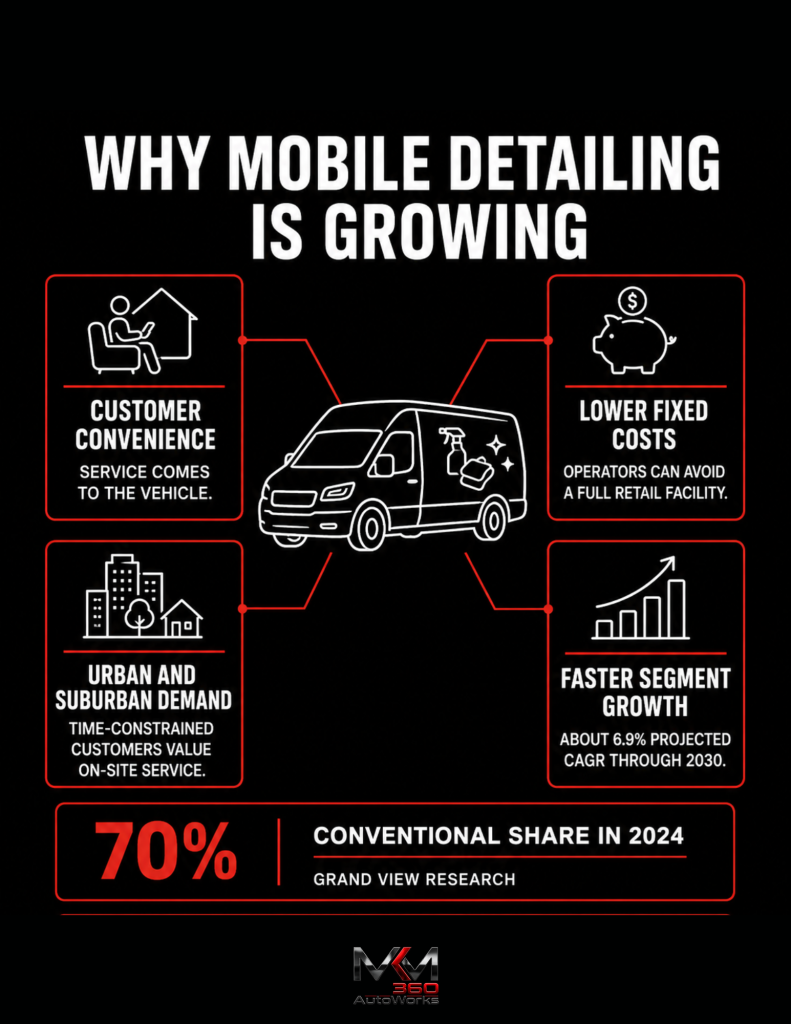
Mobile and app-based detailing is a major industry growth driver, even though fixed locations still control most of the market. Traditional brick-and-mortar facilities held a 70% market share in 2024, according to Grand View Research, while Global Market Insights placed that footprint at 52.3% for 2025. This variance simply reflects different analytical definitions of a conventional facility.
The clear momentum belongs to the mobile sector. Multiple sources project that on-demand and mobile detailing will expand at a 6.9% annual growth rate through 2030, consistently outpacing traditional service stations.
Real-world demand is currently outpacing operator capacity. Mobile-first digital platforms are expanding across the U.S. and Canada with triple-digit booking growth. Concurrently, major mobile franchise networks report thousands of unfilled monthly leads.
The appeal is straightforward – mobile detailing eliminates the need for customers to drive anywhere, book a bay, or wait in line, which matters most to time-constrained urban and suburban consumers. It also lowers the fixed-cost barrier to starting a detailing business, since operators avoid the real estate and build-out costs, often several million dollars for a single conveyor-wash site, that conventional operators face.
Ceramic Coating and Paint Protection Trends
Premium protective services are the clearest upsell trend across the industry, appearing as a named growth driver in essentially every source reviewed for this guide:
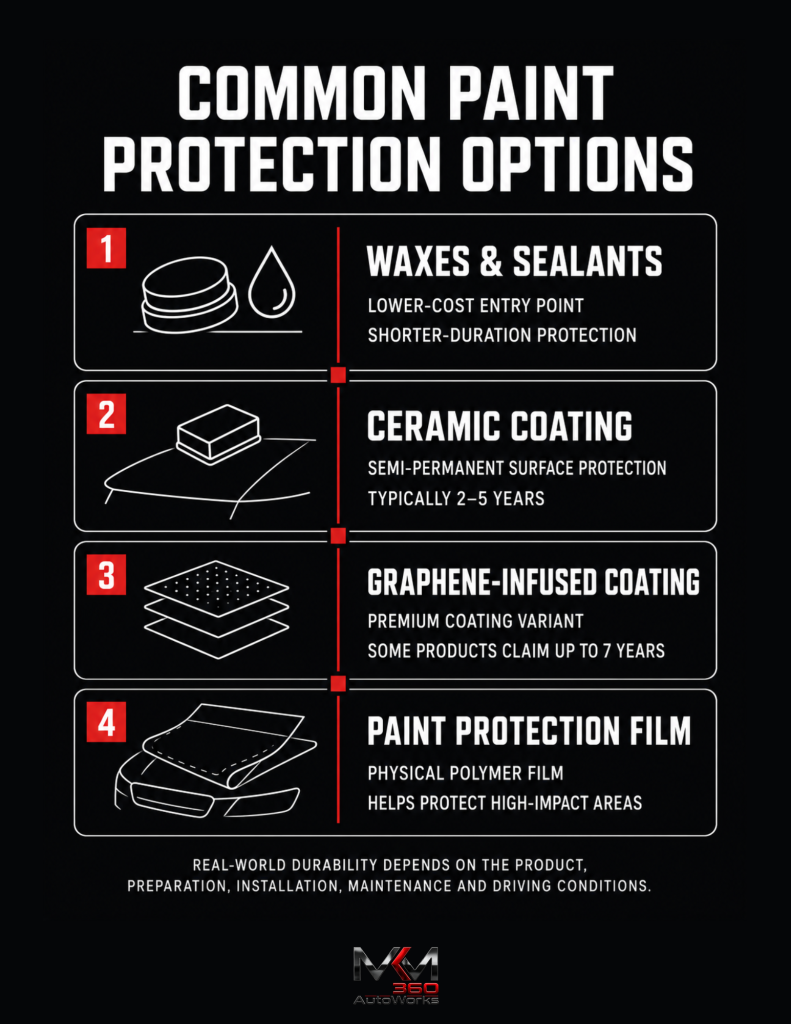
- Ceramic coatings – Also called nano-coatings or quartz coatings; semi-permanent protective layers typically lasting 2-5 years
- Graphene-infused coatings – A newer variant cited as lasting up to seven years, commanding a price premium over standard ceramic products
- Paint Protection Film (PPF) – A physical polymer film applied to high-impact areas of the vehicle body to guard against chips, chemicals, and UV damage
- Traditional waxing and sealants – The lower-cost, shorter-duration entry point into paint protection, still the most commonly purchased exterior add-on
These services are increasingly framed by the industry not as luxury add-ons but as value-preservation investments, particularly as vehicle prices rise and owners keep cars longer. Multiple sources also note strategic partnerships forming around this trend, including protective-coating providers partnering directly with vehicle manufacturers to offer PPF and ceramic coating packages as part of the new-vehicle purchase process.
Auto Detailing Business Trends
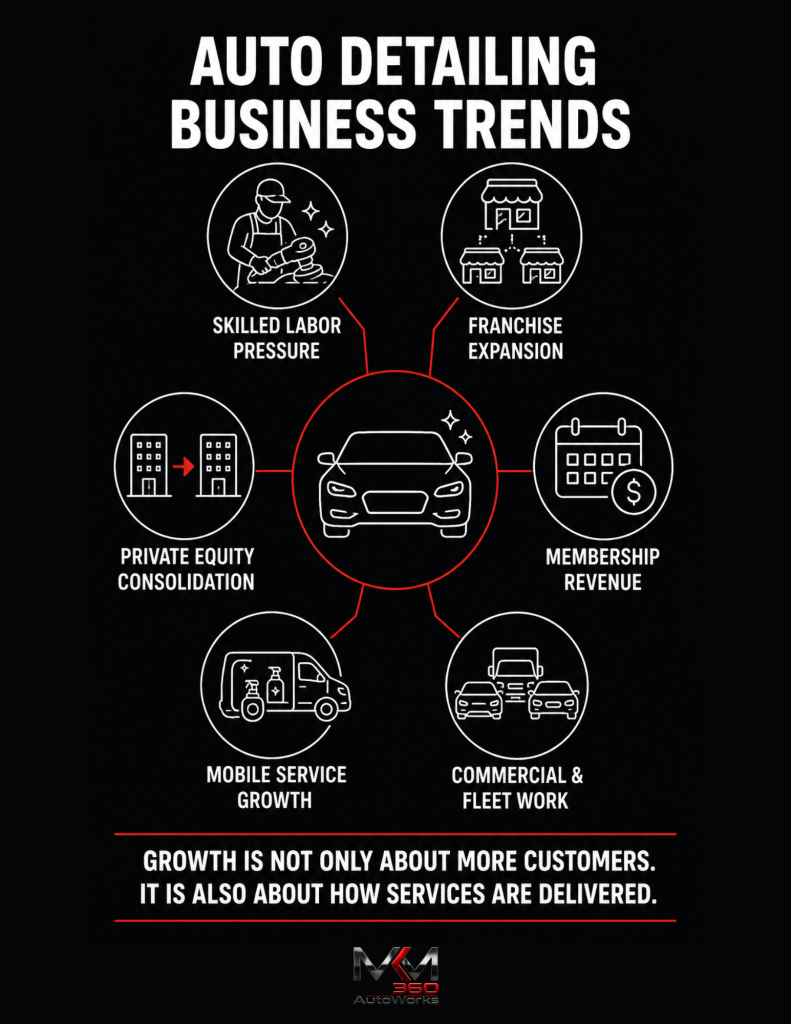
Beyond the headline market-size numbers, several structural trends show up consistently across the sources:
Extreme fragmentation
No single company controls more than a tiny percentage of total market revenue. This lack of market concentration holds true even for the largest national chains. The industry remains split up and dominated by local, independent business owners.
Skilled labor shortages
Multiple reports show that a lack of trained workers limits industry growth. This shortage impacts businesses because paint correction, coating application, and interior restoration require heavy manual labor and specific skills. Consequently, finding and keeping good employees remains a main challenge for owners.
Franchise and chain expansion
Several large brands are growing by selling franchises in domestic and international markets. This strategy allows companies to open new locations quickly without spending their own money to build them. It also creates a ready-to-use business model for new owners entering the market.
Private equity and consolidation
Investment firms are actively buying up regional car wash and detailing chains. Investors are drawn to the industry by its high profit margins, especially in quick exterior car washes, and the fact that the market is split into many small businesses. This trend is steadily combining small regional chains into larger companies.
Recurring revenue models
Monthly subscription and membership programs are popular tools for keeping business income steady. These programs turn one-time customers into regular members who pay a predictable monthly fee. This model successfully protects businesses from losing money during bad weather or slow seasons.
Commercial and fleet opportunities
Car dealerships, rental car companies, and corporate fleets represent a growing, steady source of income for detailers. These commercial accounts provide regular, high-volume work that is separate from everyday retail customers. Securing these contracts helps operators maintain steady work schedules all year long.
What These Statistics Mean for Car Owners
For drivers in Newark, DE, and the surrounding area, these numbers translate into a simple takeaway: professional detailing has moved from an occasional luxury to a routine part of vehicle ownership for a growing share of drivers nationwide. Services like interior detailing, exterior detailing, paint correction, ceramic coating, and mobile detailing aren’t niche offerings; they’re among the fastest-growing categories in an industry that’s expanding across every major research estimate.
Protecting vehicle paint from road grime and UV exposure helps maintain a clean cabin while preserving resale value. The data suggests these services pay for themselves in long-term vehicle condition, which is exactly why demand keeps climbing.
Frequently Asked Questions
How big is the auto detailing industry?
Estimates vary by scope. The U.S. car wash and auto detailing industry generates roughly $14.6-18.6 billion annually, depending on the year and data source. The global car detailing services market is estimated between roughly $39 billion and $46.7 billion as of 2025, with most forecasts projecting growth to $58–71 billion by the 2030-2035s.
Is the car detailing industry growing?
Yes. Every major research firm covering this market, like Grand View Research, Fortune Business Insights, Global Market Insights, and Precedence Research, projects continued growth through at least 2030, with global CAGR estimates clustering between roughly 5.6% and 6.14%.
How many auto detailing businesses are there in the U.S.?
Estimates range from roughly 55,000 to 60,000 businesses, including car wash and detailing operators, as of 2024, per IBISWorld-sourced data. The industry is highly fragmented, with the vast majority operating as single-location, independently owned businesses.
What is the difference between a car wash and auto detailing?
A car wash is a faster, largely automated exterior cleaning service. Auto detailing is a more labor-intensive, comprehensive service covering interior deep cleaning, paint correction, ceramic coating, PPF, and full reconditioning, typically at a higher price point and lower volume than a standard wash.
Why is mobile detailing growing?
Mobile and on-demand detailing removes the need for customers to travel to a fixed location, appealing to time-constrained consumers. It also has a lower barrier to entry for operators, since it avoids the multi-million-dollar real estate and build-out costs of a fixed conveyor-wash facility. Reflecting this consumer shift, independent auto detailing industry statistics track mobile services as a distinct and rapidly growing market segment.