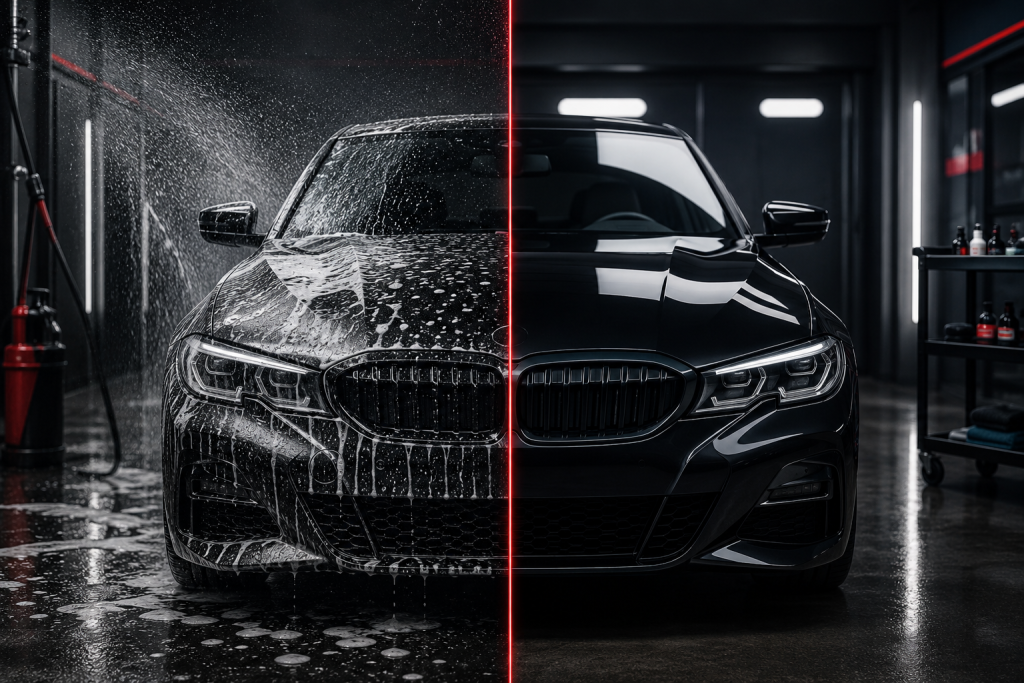
Most people have booked a car wash thinking it would sort things out, only to find the paint still looks dull or the interior still smells off. That gap between expectation and result usually comes down to one thing – not knowing the difference between a car wash and detailing. They are not the same service, and using one when you need the other is an easy mistake.
Understanding the difference between car detailing vs car washing helps you make smarter decisions about your vehicle’s care. In this guide, you’ll learn exactly what each service involves, when to choose one over the other, and what to look for when your car genuinely needs more than a rinse and a dry.
Car Detailing vs Car Wash
Professional car detailing is an intensive, hours-long hand restoration process that deep-cleans and protects the entire vehicle. In contrast, a basic car wash provides a quick exterior clean that removes surface dirt in minutes. Detailing maintains long-term value, while a wash provides just a temporary shine.
What is a car wash?
A car wash is routine maintenance. It removes dirt, dust, pollen, mud, and road grime that build up during everyday driving, keeping the vehicle presentable between deeper cleans. According to Research and Markets, the global car wash market is valued at $35.19 billion in 2025 and is projected to reach $45.24 billion by 2030. That’s a reflection of how deeply ingrained regular washing has become in vehicle ownership worldwide.
The process is straightforward: the exterior is rinsed, washed with shampoo or car soap, and dried. Wheels and tires are cleaned separately, and the glass is wiped down. Some car washes offer a quick vacuum or interior wipe as an add-on, but that is a convenience extra, not interior detailing, and not a replacement for it.
What is car detailing?
Car detailing is not a more thorough car wash. It is a different service with a different purpose: to clean, restore, and protect the vehicle rather than simply clear the surface. According to Fortune Business Insights, the global car detailing service market was valued at $38.93 billion in 2025 and is projected to reach $62.98 billion by 2034.
On the exterior, the process goes well beyond soap and water, including iron fallout removal, clay bar decontamination, and paint correction, all of which address contamination that a wash cannot touch. A wax, sealant, or ceramic coating is then applied to protect the finish. Inside, every surface is properly worked through: vacuuming, shampooing, leather conditioning, and odor extraction. It is a full reset, not a deeper version of the same thing.
Car Detailing vs Car Wash – Quick Comparison
| Factor | Car Wash | Car Detailing |
| Main Purpose | Surface cleaning | Deep cleaning, restoration, protection |
| Exterior | Wash, rinse, dry | Wash, decontamination, wax/sealant, polishing options |
| Interior | Minimal or none | Vacuuming, shampooing, wipe-down, leather care |
| Time | Usually minutes | Usually hours |
| Paint Protection | Limited or none | Wax, sealant, ceramic coating options |
| Best For | Routine upkeep | Full vehicle reset or long-term care |
Exterior Cleaning – Car Wash vs Exterior Detailing
For a light weekly buildup, a standard car wash is sufficient. However, its limitations become apparent once contaminants bind to the finish. Bugs release acids that etch clear coat, tar bonds on contact, and tree sap contracts as it cures, pulling at the paint. None of these shifts requires soap and water alone.
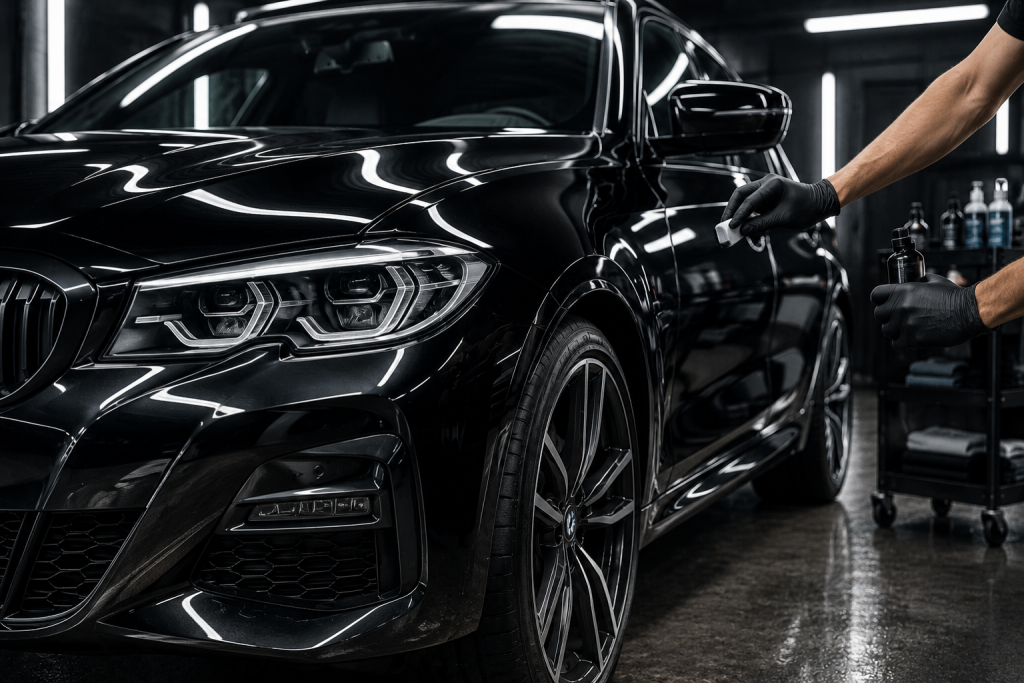
This is where the distinction between a car wash and auto detailing becomes practical. A proper exterior detail removes these stubborn elements through hand washing, bug and tar removal, iron fallout treatment, and clay-bar decontamination. Technicians then apply a machine polish where needed and seal the finish with a wax, sealant, or ceramic coating.
The clear coat risk of automatic washes
Automatic tunnel washes damage paint over time. Brushes and towels drag trapped grit across your clear coat, creating circular swirl marks that dull the finish. Because a modern clear coat is only 40 to 80 microns deep, roughly the width of a human hair, repeated polishing to fix surface damage will eventually strip the protective layer entirely, requiring an expensive respray.
To prevent this, booking a full exterior detail in spring or early summer is ideal. This process safely removes winter road salt and grit from paint and wheel wells, stopping hidden corrosion before it ruins your vehicle’s finish.
Interior Cleaning – Basic Cleaning vs Interior Detailing
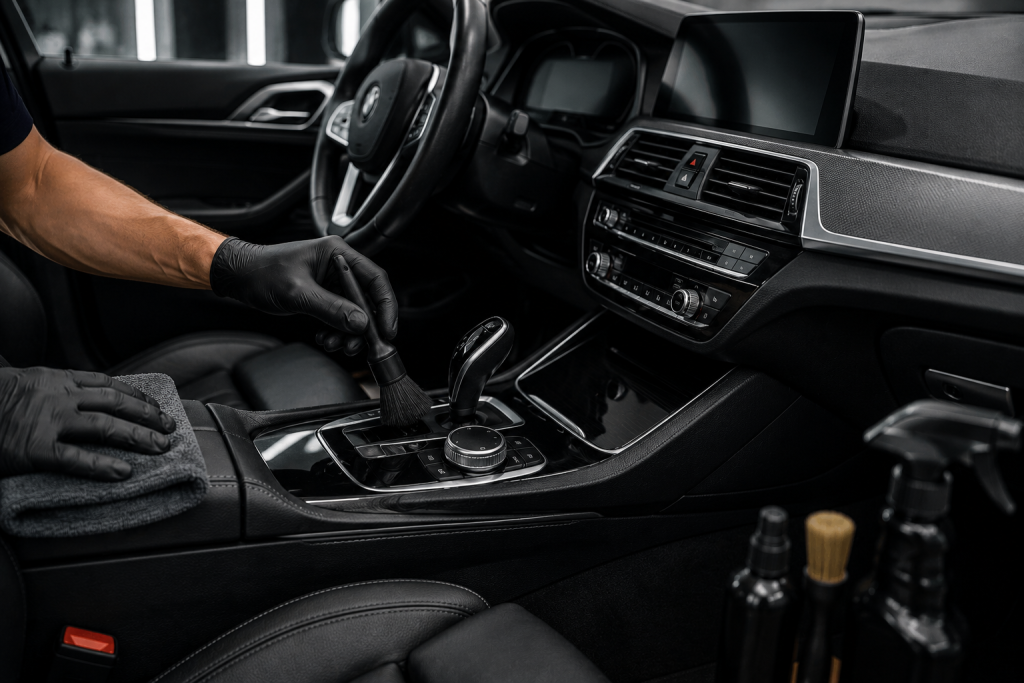
Basic interior cleaning only covers visible surfaces with a quick vacuum and wipe-down. While adequate for weekly upkeep, it doesn’t address deep-seated grime.
Conversely, true interior detailing targets every surface systematically to remove embedded contaminants:
- Fabric extraction – Vacuuming and shampooing seats, carpets, and the boot to destroy trapped odors at the source
- Crevice cleaning – Purging air vents, cup holders, and trim gaps of debris that a standard wipe misses
- Leather care – Cleaning and conditioning leather in sequence to lift dirt without damaging the material
- Glass clarity – Deep cleaning all glass surfaces to eliminate haze and restore visibility
Ultimately, a basic cleaning temporarily improves how your cabin looks, but a dedicated interior detail sanitizes and restores the actual materials.
Does Detailing Include Paint Protection?
Most standard detailing packages include baseline protection, such as wax or paint sealants, which shield the clear coat from UV rays and contamination. Wax lasts a few weeks, while synthetic sealants offer several months of durability.
Premium packages include ceramic coatings that bond chemically to create a hard, hydrophobic barrier that lasts for years. However, because ceramic coatings are completely transparent, they lock in existing imperfections rather than hiding them; therefore, paint correction is usually required beforehand. It is also important to note that ceramic coatings cannot prevent stone chips. For impact resistance, paint protection film (PPF) must be applied as a physical urethane barrier to high-impact areas like the bumper and bonnet.
Advanced treatments like ceramic coatings, PPF, and paint correction are premium add-ons. Vehicle owners should explicitly request them rather than assuming they are included in a standard car detailing booking.
When Should You Choose a Car Wash?
A car wash is ideal when a vehicle only requires minor maintenance, such as removing light surface dirt or completing a quick refresh. Using a basic wash is perfect for maintaining conditions between comprehensive detailing, provided the paint is in good condition, and the interior is already clean.
As a general guideline, a wash every two to four weeks keeps everyday surface buildup under control. However, regular travel on rural routes, motorways, or winter roads contaminates paint much faster than light urban driving, requiring more frequent cleanings.
When Should You Choose Car Detailing?
Car detailing is necessary when a standard wash cannot restore the vehicle’s condition. A full detail is the right choice in these specific scenarios:
- Bonded contamination – Exterior paint feels rough, looks dull, or shows oxidation
- Deep interior grime – The cabin has stubborn stains, pet hair, or persistent odors
- Neglected maintenance – The vehicle hasn’t had a deep clean in six months or longer
- Surface protection – The goal is to apply long-term wax, sealants, ceramic coatings, or paint protection film
- Presale preparation – The vehicle is being prepared for resale or trade-in to maximize value
As a general baseline, daily drivers exposed to harsh weather require a detail twice a year. For well-maintained vehicles stored in a garage, an annual service is sufficient to preserve the finish.
Conclusion
Ultimately, navigating the choice between a car detailing vs car wash comes down to your vehicle’s current condition. A standard wash handles routine maintenance to keep the car visually presentable, while periodic detailing steps in for deep paint decontamination, cabin resets, and long-term protective coatings.
By utilizing both services at the right times, you eliminate the guesswork of vehicle maintenance and protect your investment. Balancing regular surface cleaning with deeper restoration preserves both the vehicle’s true condition and its eventual resale value.