Your car doesn’t care where it gets cleaned. You do, because the choice affects your schedule, your budget, and how well your paint actually gets protected. Mobile detailing vs shop detailing can both deliver excellent results, but they’re built for different jobs, and picking the wrong one for your situation is the most common way people waste money on a detail.
This guide breaks down exactly when each option makes sense, what mobile vs shop car detailing differences actually matter, and how mobile detailing stacks up against a basic car wash, too.
Mobile Detailing vs Shop – Main Difference
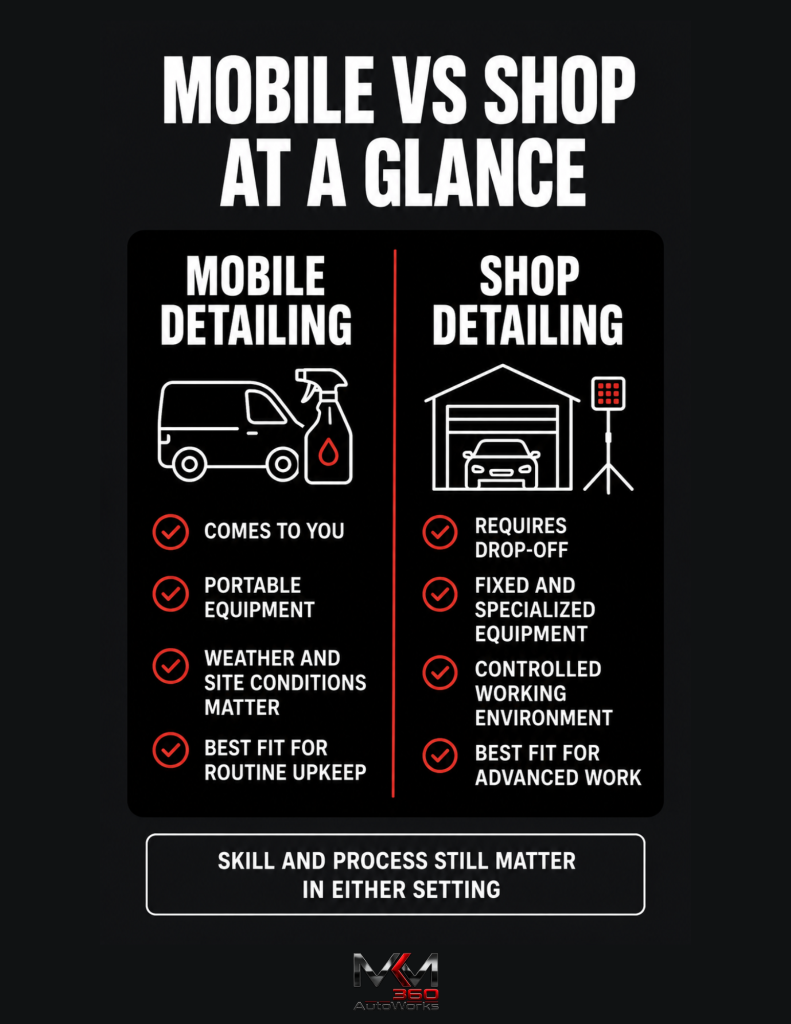
The main difference between mobile detailing and shop detailing is where the service takes place. Mobile detailing comes to your home, workplace, or another convenient location, while shop detailing requires you to bring your vehicle to a dedicated facility.
That difference in location creates different working conditions. Mobile detailers work outdoors or in your garage using portable water tanks, generators, and compact equipment. Detail shops work indoors with climate control, bright lighting, and professional equipment designed for more demanding services.
For common detailing services, both options can deliver excellent results when performed by an experienced technician. However, the work environment becomes more important for services that require precise lighting and stable temperatures. Paint correction and ceramic coating are two of the best examples because they benefit from controlled indoor conditions.
In most cases, mobile detailing is the better choice for regular maintenance and convenience. Shop detailing is usually the better option for advanced paint correction, ceramic coatings, and other services that require a controlled environment.
Comparing Mobile and Shop Detailing
The biggest differences between mobile and shop detailing come down to convenience, working conditions, equipment, and the type of service being performed.
| Factor | Mobile Detailing | Shop Detailing |
| Convenience | Higher, service comes to you | Lower, requires vehicle drop-off |
| Environment | Weather-dependent | Controlled lighting and climate |
| Equipment | Portable tools and systems | Larger, specialized equipment |
| Best For | Routine cleaning and maintenance | Advanced detailing and restoration |
| Services | Interior and exterior upkeep | Paint correction, coatings, and repairs |
| Scheduling | More flexible appointments | Requires a set drop-off window |
Weather is one of the main factors that separates the two options. Mobile detailers can complete many jobs in different conditions, but rain, wind, and extreme temperatures may affect scheduling or product performance. Shop detailing has an advantage for services that require stable conditions, such as ceramic coatings or paint correction.
Equipment differences are mostly about scale rather than capability. Professional mobile detailers carry high-quality tools like extractors, polishers, and pressure washers, while shops can offer larger setups such as multiple work bays, lifts, and specialized equipment.
When Mobile Detailing Makes Sense
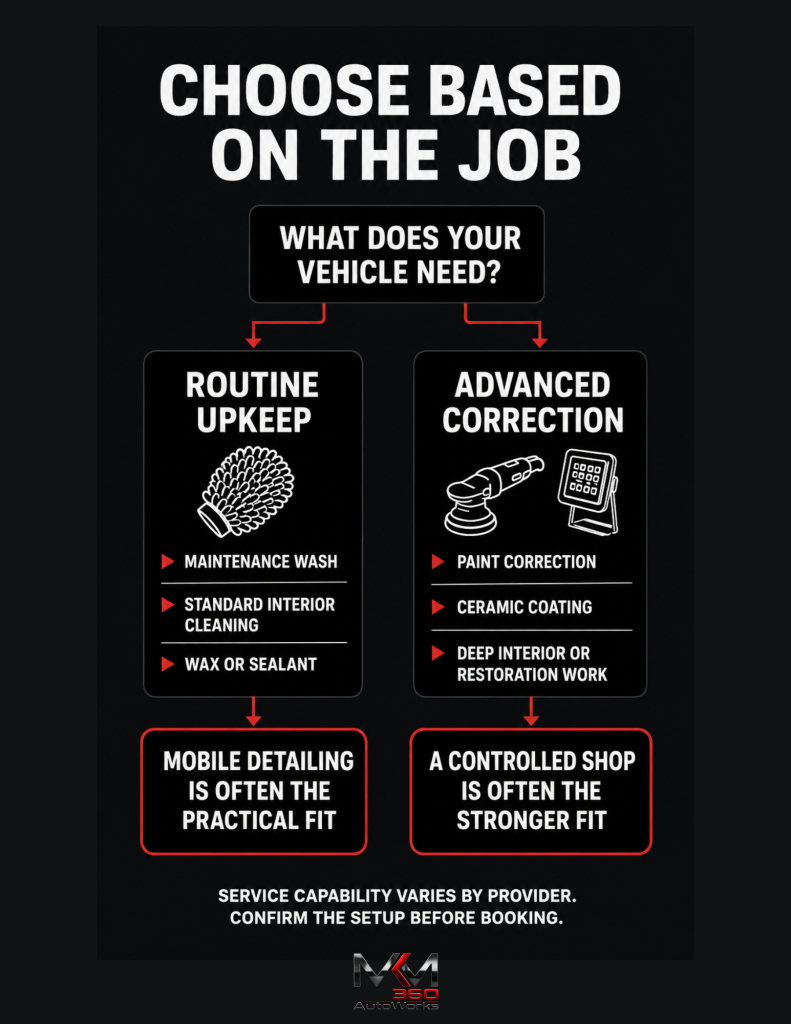
Mobile detailing is the better choice when convenience and regular maintenance are the priority. It works well for:
- Busy schedules – No driving, waiting, or arranging transportation
- Routine upkeep – Ideal for washes, interior cleaning, and light protection
- Vehicles in good condition – Best when there are no major issues like oxidation, swirl marks, or heavy stains
- Limited time or travel options – A practical choice when you want service at home or work
- Basic detailing needs – Not the best fit for major correction, coatings, or restoration
For regular maintenance, mobile detailing is often the more practical option. It allows you to keep your vehicle clean and protected without spending hours at a detailing facility.
When Shop Detailing Makes Sense
Shop detailing is better suited for services that require a controlled environment and specialized equipment, including:
- Paint correction – Swirl marks, oxidation, and deeper defects are easier to fix with consistent lighting and workspace
- Ceramic coatings – Controlled temperature, humidity, and a cleaner environment help ensure proper application and curing
- Deep interior cleaning – Heavy extraction, odor removal, and restoration benefit from more equipment and workspace
- Poor weather conditions – Indoor facilities avoid issues caused by rain, extreme heat, or cold
- Detailed inspection work – Fixed lighting makes it easier to identify small imperfections
Shop detailing is usually the preferred option for advanced correction and restoration because the environment provides better control. The difference is not technician skill, but the conditions required for more sensitive services.
Mobile Detailing vs Car Wash Which Is Better?
Mobile detailing and car washes serve different purposes. A car wash focuses on speed and basic exterior cleaning, while mobile detailing offers a more comprehensive service to maintain the vehicle’s appearance and condition.
A car wash removes surface dirt, road grime, and debris with minimal time and effort. Mobile detailing goes further with hand washing, interior cleaning, wheel and trim care, and protective treatments such as car sealants or spray wax. It also allows more attention to areas that automated washes often overlook.
For a quick clean before an event or regular surface maintenance, a car wash may be enough. For deeper cleaning, interior care, and long-term protection, mobile detailing offers greater value by helping maintain your vehicle’s appearance and condition.
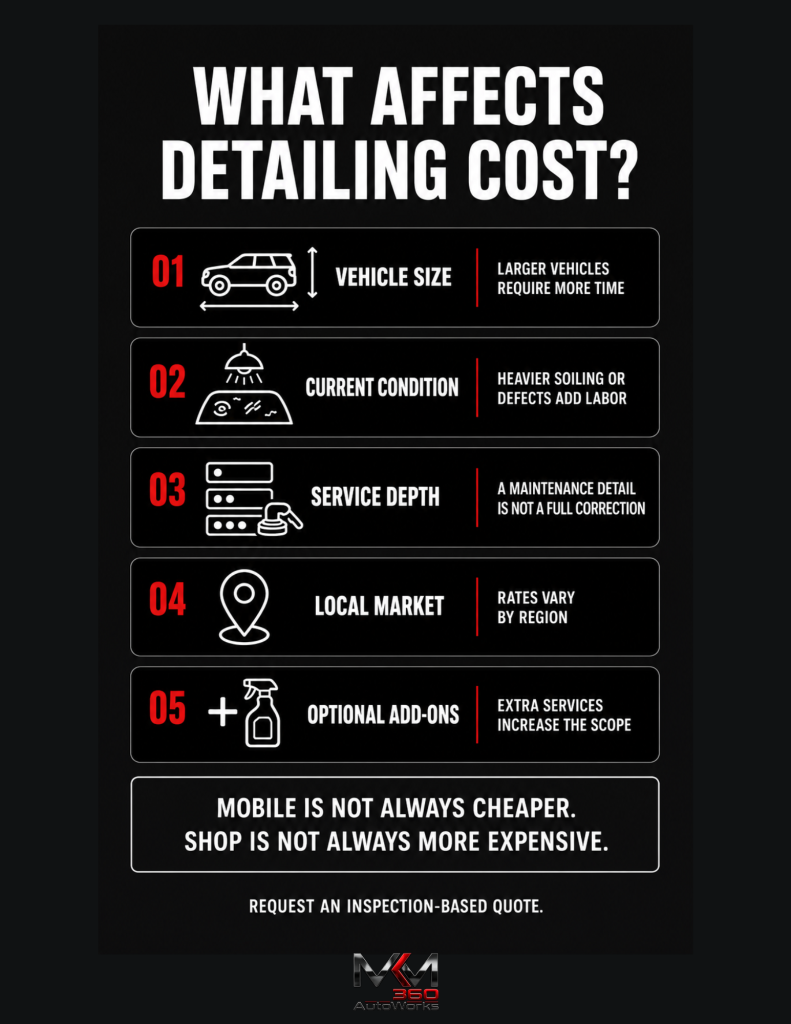
Choosing the Right Setting for Different Detailing Services
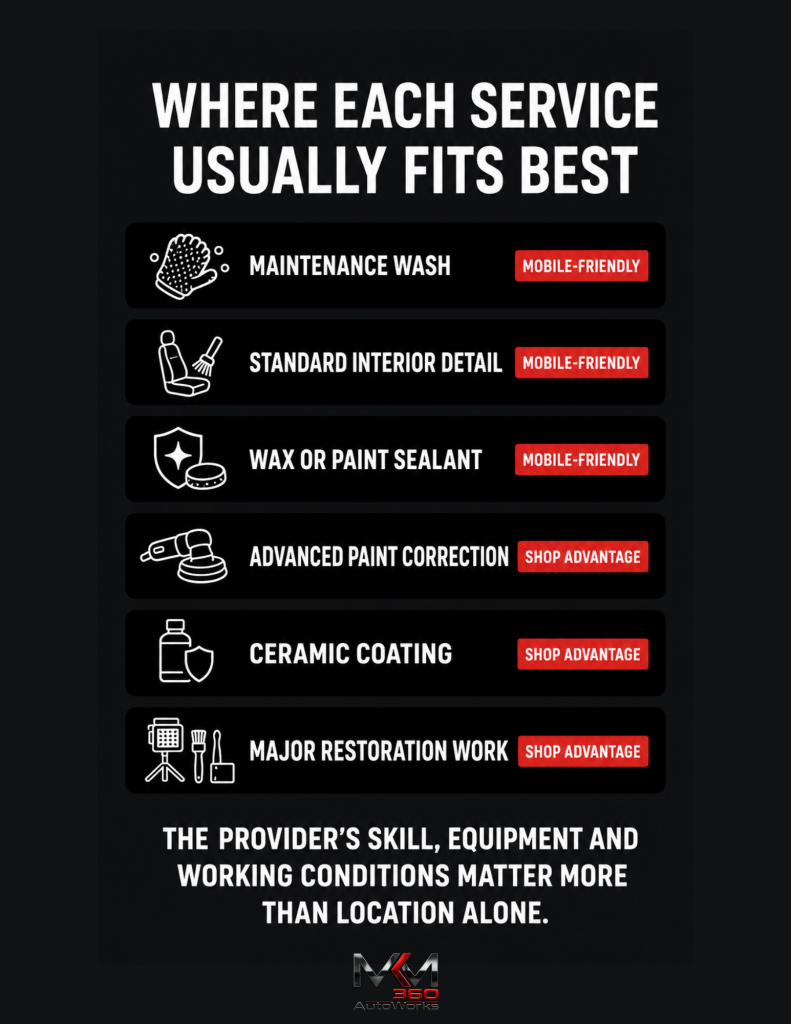
Surface decontamination such as clay bar treatment for bonded contaminants can also be performed in either setting when the technician has proper lubrication and a clean working area. Mobile detailing works well for regular maintenance tasks such as exterior cleaning, interior upkeep, and applying basic protection products. It is also a practical option for services like headlight restoration when the technician has the right tools and setup.
More demanding services often require the controlled conditions available at a detailing facility. Work such as advanced paint correction, ceramic coating application, deep extraction, heavy-odor treatment, and major restoration typically benefits from specialized equipment, additional workspace, and a more controlled process.