
You notice it walking up to your car – a scratch slicing across your door panel, catching the light perfectly. Your immediate instinct is to book a detailing appointment and hope for a quick fix. But does car detailing remove scratches, or is that wishful thinking?
Handing over your keys expecting a flawless repair can often lead to disappointment, as a standard service cannot simply erase every type of paint damage. To help you set the right expectations, this guide breaks down how to identify your scratch depth, which detailing methods work, and when a standard service is not enough.
Does Car Detailing Remove Scratches?
Whether car detailing removes scratches, it depends entirely on the depth of the scratch relative to your car’s paint layers. Detailing completely erases light, surface-level blemishes in the clear coat, but deep gouges penetrating the primer or bare metal require specialized auto body repair.
The universal desire to fix these imperfections drives massive commercial demand for paint restoration. According to Coherent Market Insights, the global car scratch remover market is valued at $2.52 billion in 2026 and is projected to reach $4.34 billion by 2033.
When Can Car Detailing Remove Scratches?
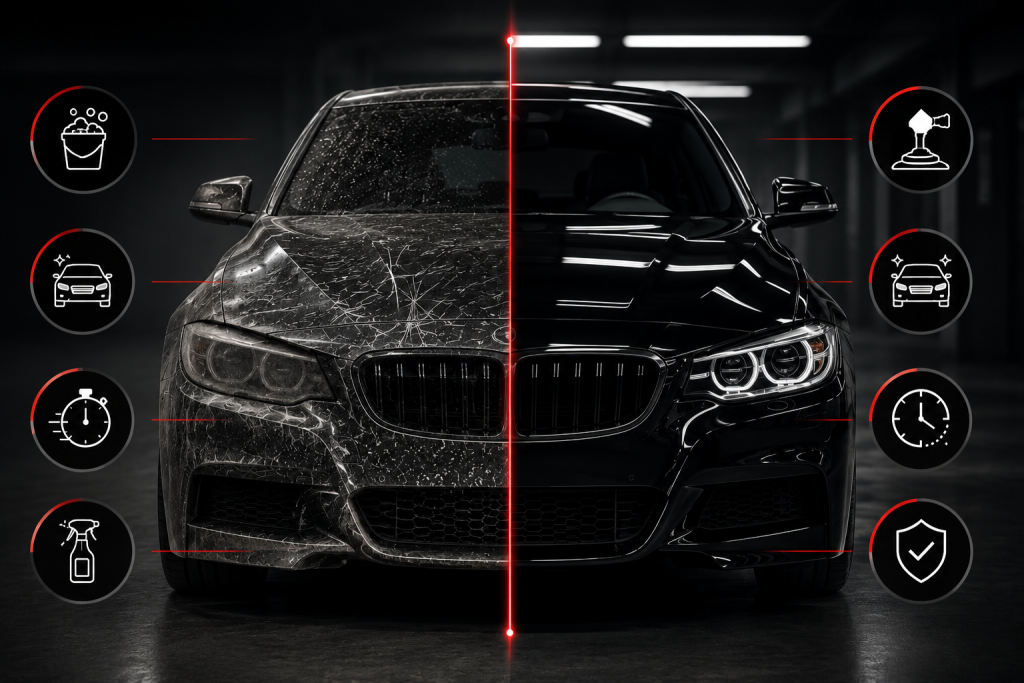
Detailing works best on surface-level defects that only affect the clear coat. Your car’s finish consists of several layers: primer, base coat, color, and a clear coat on top. That last layer is the one that detailing can actually work with. So does detailing remove scratches that sit within this layer? In most cases, yes.
Light scratches, swirl marks, fine wash marks, minor oxidation, paint transfer, and light scuffs that stay within the clear coat can all be addressed through polishing or compounding. Paint transfer is worth singling out here as it’s foreign paint deposited onto your clear coat from contact with another surface, and in many cases, a clay bar treatment or light polish removes it without any correction needed.
Polishing and compounding work by shaving down the clear coat around the scratch until the surface sits level and the defect disappears. If the damage is still within the clear coat, a detailer can usually remove it completely.
When Is Detailing Not Enough?
Once a scratch penetrates the clear coat, standard polishing cannot fix it. Damage reaching the color coat, primer, or bare metal requires professional intervention. According to Coherent Market Insights, a major limitation of standard scratch removers is their inability to fix serious damage, forcing consumers to seek advanced repair services. Left untreated, exposed metal will rust, turning a cosmetic issue into structural damage.
Choosing the right fix depends on the severity of the damage:
- Touch-up paint – Best for small, isolated chips with exposed metal
- Wet sanding – Necessary for deep, serious damage over a wider area
- Repainting and bodywork – Required when large panels are damaged, or the paint has deteriorated
Vehicle color also impacts visibility. Darker colors, like black, deep grey, and navy, reveal scratches much faster than white or silver cars. The damage isn’t deeper; the contrast just makes it highly visible.
How to Tell What Kind of Scratch You Have
Two quick checks will give you a clear picture of what you’re dealing with before you call anyone.
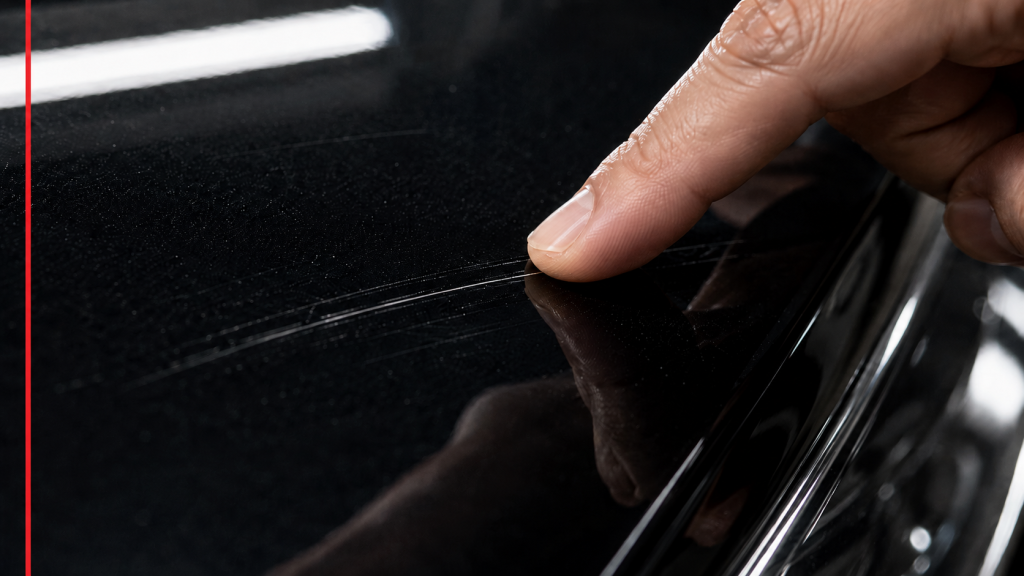
The fingernail test
Drag your fingernail lightly across the scratch. If it glides over smoothly, the damage is likely surface-level, and polishing may remove it. If your nail catches, the scratch is deeper and will probably need paint correction or repair. If it’s borderline, clean the area first, as dirt in a scratch can mimic the feel of a deeper groove.
Check the scratch color
A white or cloudy mark is usually limited to the clear coat. A colored scratch suggests it may have reached the paint beneath. Gray or dark marks point to primer or bare metal. And if there’s rust, detailing isn’t the answer.
What Detailing Methods Help With Scratches?
The right detailing method depends entirely on the damage depth. For shallow clear-coat imperfections, detailers use paint correction to level the surrounding finish. Polishing serves as the starting point, utilizing fine abrasives to eliminate light scratches, swirl marks, and surface dullness.
When polishing is insufficient, detailers use compounding, an aggressive cutting process designed for deeper scratches. Compounding always requires a subsequent finishing polish to restore clarity. Depending on defect severity, technicians apply either a single-stage correction for moderate oxidation or a multi-stage correction that aggressively cuts the clear coat before refining it to eliminate deep scratches, buffer trails, and chemical etching.
However, removing too much clear coat permanently weakens the paint system. Experienced detailers always measure paint thickness with a digital gauge before compounding to avoid burning through the protective finish.
Exterior Detailing vs Paint Correction
Many car owners assume a standard car detailing package automatically includes paint restoration. In reality, determining whether car detailing removes scratches is essential before booking a service, as true scratch removal requires specialized car paint correction rather than basic cleaning.
A standard exterior detail focuses strictly on cleaning and preservation, covering washing, decontamination, clay-bar treatments, and protective sealants. While this leaves the vehicle clean, it doesn’t remove scratches.
Conversely, paint correction is a separate service using machine polishers and abrasive compounds to level the clear coat and eliminate defects. This labor-intensive process targets the actual damage, with the overall effort driven by vehicle size, paint hardness, and defect severity.
Scratch Repair vs Scratch Cover-Up
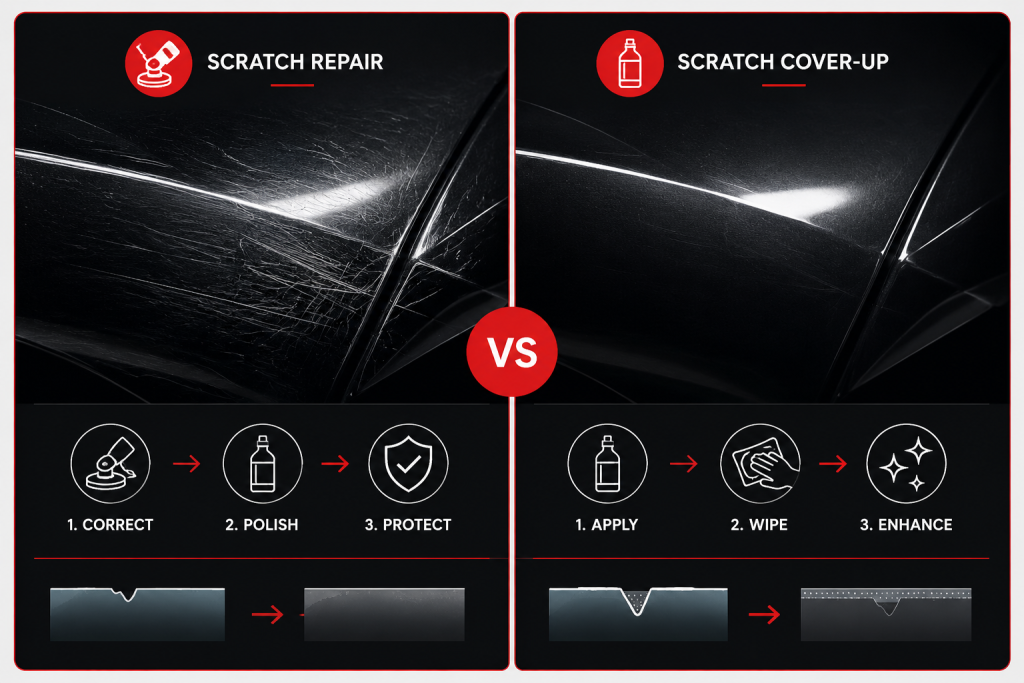
Scratch repair physically eliminates or levels defects using permanent paint correction methods such as compounding and polishing. In contrast, scratch cover-ups offer only a temporary mask. While waxes, glazes, and fillers use optical compounds to hide damage by reflecting light more evenly, these cosmetic layers wash away after a few weeks, leaving the original scratch completely exposed.
Can Detailing Prevent Future Scratches?
Proper maintenance and protection are critical to preventing future surface damage. Because improper wash techniques cause more paint defects than any other source, avoiding automatic brush car washes is the most effective preventative measure.
Hand washing with microfiber towels removes abrasive road grime before it can scratch the finish during cleaning. For ongoing protection, specialized detailing coatings add essential defensive layers:
- Waxes and sealants – Provide short-term, sacrificial barrier layers against light friction
- Ceramic coatings – Deliver long-lasting, chemical-resistant hardness that repels minor swirl marks
- Paint protection film (PPF) – Offers the ultimate physical barrier to absorb rock chips and deep scratches before they ever reach the paint
Conclusion
Not every scratch is a crisis, and not every scratch is a quick fix. So does car detailing remove scratches? It depends entirely on how deep the damage goes. Surface-level defects respond well to polishing and correction. Anything deeper needs a different conversation.
A professional detailer can take a look, give you an honest assessment, and point you in the right direction, whether that’s a polish, a full correction, or a repair. Getting the right answer early saves time, money, and the frustration of paying for something that won’t actually solve the problem.